
The Man co-Invented Technology Inside 80% of Solar Panels. He Believes Vietnam Has Everything It Needs to Build an Energy Self-Reliance Future”
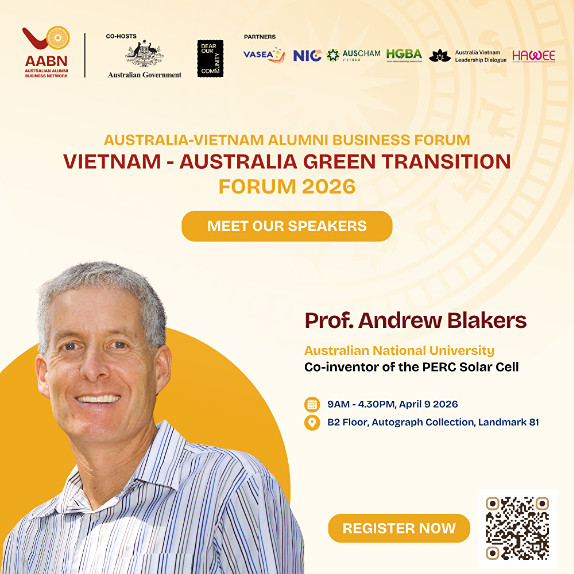
One of Australia's most recognized solar engineers, Professor Andrew Blakers, has spent four decades reshaping how humanity captures and stores clean energy. Now he’s bringing that blueprint to Vietnam - a nation he calls one of the most renewable-ready countries on Earth.
When Andrew Blakers graduated from the Australian National University with a degree in physics in the late 1970s, solar panels were curiosities bolted to satellites, expensive, fragile, and deeply impractical. Nearly five decades later, the technology he helped invent - PERC (Passivated Emitter and Rear Cell) - now wraps half the solar panels on the planet, the dominant solar cell technology applied globally across major markets. Australian technology is deeply embedded in practically every solar module sold around the world today.
Key Achievements

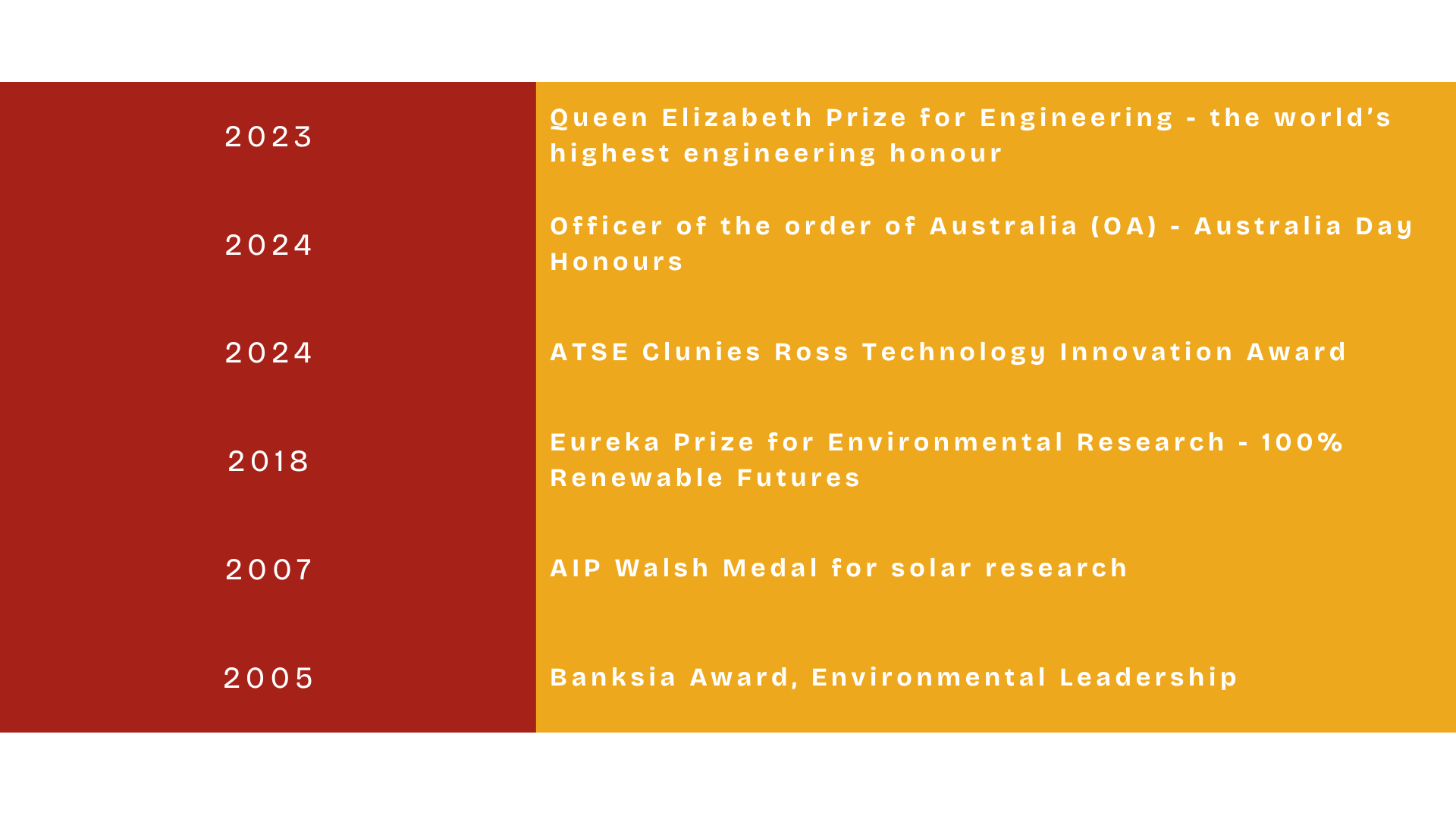
KEY HONOURS
THE INTERVIEW
Q: YOU SPENT DECADES BUILDING BETTER SOLAR CELLS. WHAT MADE YOU PIVOT TOWARD THE QUESTION OF 100% RENEWABLE ENERGY SYSTEMS?
It became obvious around a decade ago that solar was going to take over the world. The cost curves were undeniable, exponential and relentless. But it was equally obvious that it couldn’t do that without adequate energy storage, particularly for overnight. Batteries, at the time, were prohibitively expensive. So pumped hydro became the central question.
I’d always been engaged in environmental protection, the idea of damming every river in sight was a non-starter. That pushed my team toward off-river sites. We conducted a GIS survey of the entire surface of the globe, excluding polar regions and protected areas. What we found changed the conversation entirely: roughly a million viable sites worldwide. Energy storage, it turns out, is a solved problem.
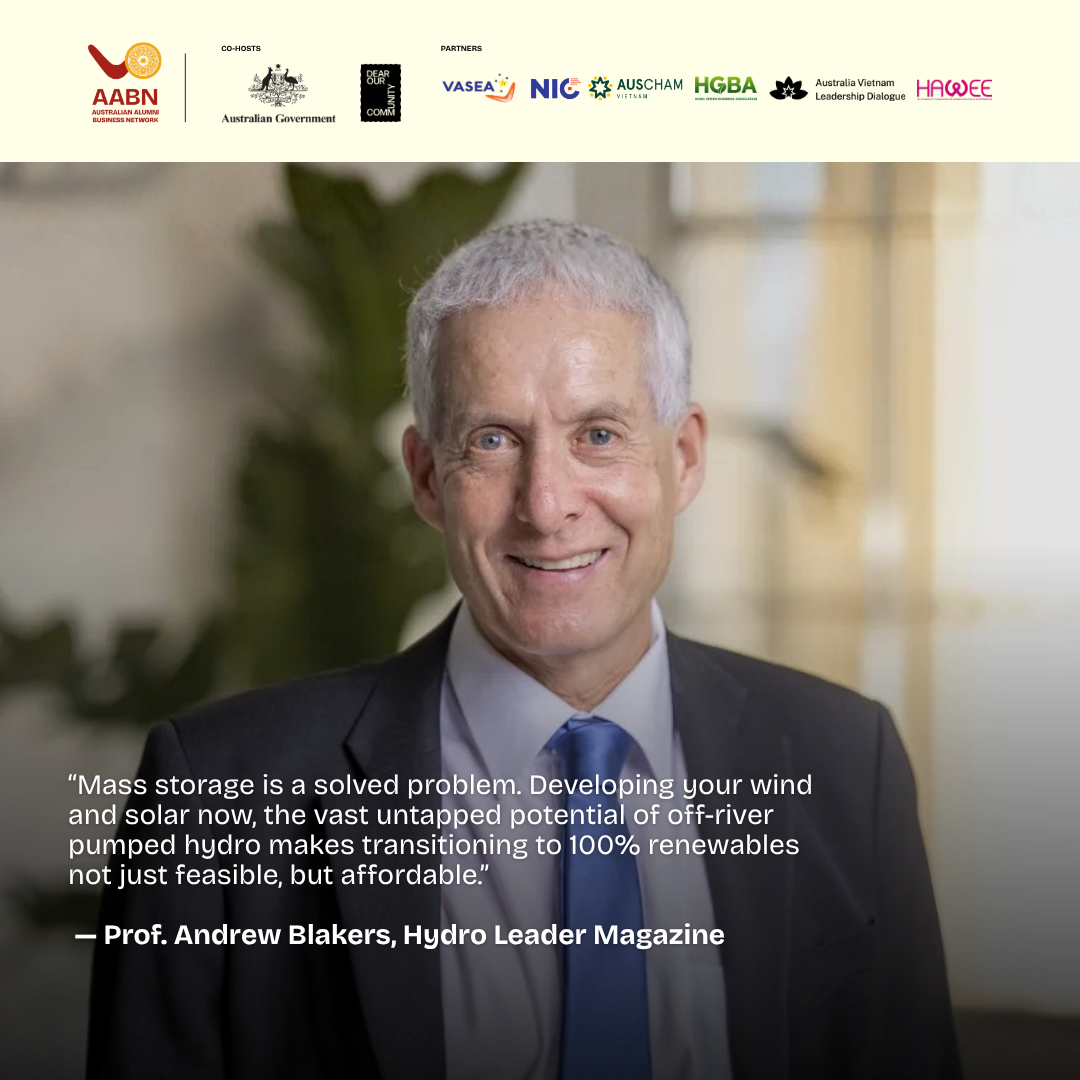
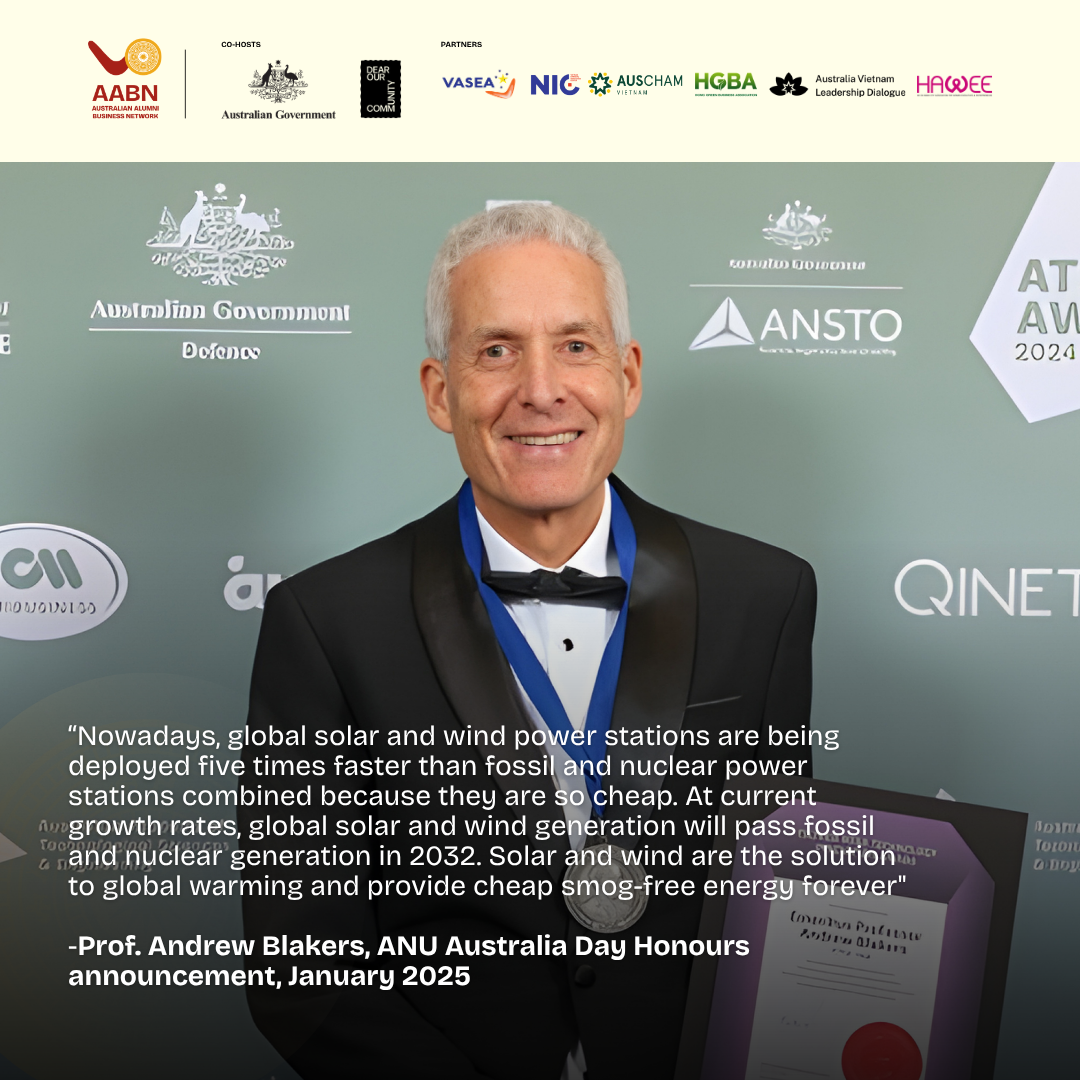
Prof. Andrew Blakers is leading 100% Renewable Energy Group at Australian National University
Q: AUSTRALIA is tracking from 12% renewable electricity in 2015 to 82% in 2030. WHAT DOES THAT TRAJECTORY ACTUALLY LOOK LIKE FROM THE INSIDE?
It looks like a series of myths collapsing, one by one. When we started pushing the idea of high renewable penetration, we were told the grid would become unstable. It didn’t. We were told storage would be unaffordable. It isn’t. We were told electricity prices would spiral. Rooftop solar has instead given Australian households the cheapest domestic energy in the country’s history.
The transition has also demonstrated resilience in ways nobody quite anticipated. Trade tensions, a global pandemic, regional conflict - none of these disrupted an energy system built on sunlight and wind. You can’t embargo the sun. You can’t blockade the breeze. For countries that currently rely on fossil fuel imports, that’s a profound strategic advantage.
Q: YOUR PERC SOLAR CELL TECHNOLOGY NOW UNDERPINS ROUGHLY HALF OF ALL SOLAR PANELS EVER MANUFACTURED. HOW DOES IT FEEL TO SEE THAT IN THE WORLD?
It’s been a privilege to work in solar energy since 1979 and watch the industry grow from tiny deployments on satellites into a global juggernaut. PERC was fundamentally about efficiency, getting more electrons out of each photon by passivating the rear surface of the cell.
What the Queen Elizabeth Prize recognition in 2023 meant, beyond the personal honour, was a signal that engineering for clean energy has arrived at the top of the prestige hierarchy. Engineering prizes don’t get more prestigious than that. It matters for the students and researchers who come after.
Q: VIETNAM IS THE FOCUS OF YOUR UPCOMING VIETNAM-AUSTRALIA GREEN TRANSITION FORUM. WHAT DOES THE AUSTRALIAN MODEL ACTUALLY OFFER A COUNTRY LIKE VIETNAM?
Vietnam has world class wind, solar, and pumped hydro resources. The geography is compelling. The significant elevation changes across the country create natural candidates for off-river pumped hydro storage. Off-shore and highland wind resources are substantial. Solar irradiance is strong. The fundamentals are there.
What Australia’s experience shows is that a country can move very fast when policy and investment align. Going from 12% to 82% renewable generation in 15 years is both a cultural shift and a deliberate engineering and economic choice. Nearly 40% of dwellings have rooftop solar. And critically, the grid stayed stable throughout and electricity prices are unchanged. Greenhouse emissions fell rapidly. Urban air quality improved. Electrification of transport and industry follows naturally.
There are myths that may still prevail in Vietnam that storage is unsolved, that grids become unreliable at high renewable penetration, that the cost is prohibitive. Australia has broken each of these myths empirically. Vietnam doesn’t need to repeat Australia’s learning curve, it can leapfrog this transformation. And it will be even cheaper than in Australia because renewable costs keep falling.
Q: YOU’VE MODELLED 100% RENEWABLE PATHWAYS FOR COUNTRIES ACROSS ASIA, LATIN AMERICA, AND SOUTHEAST ASIA. WHAT SEPARATES COUNTRIES THAT MOVE QUICKLY FROM THOSE THAT STALL?
Confidence, mainly. Technical confidence that the system works; economic confidence that the costs are manageable; political confidence that the transition is irreversible. The modelling consistently shows that for countries in the sunbelt, and Vietnam sits squarely in it, the levelized cost of a fully renewable system is competitive with or cheaper than new fossil fuel capacity.
What stalls transitions is usually a combination of challenges, unclear policies, uncertainty about storage, and a lack of local champions who have done the hour-by-hour modelling to prove it works for that country’s specific geography and demand profile. My team at ANU has done that work for East Asia, Indonesia, and neighbouring countries. The numbers are unambiguous: the resources are abundant, the technology is off-the-shelf, and the cost is low. If in doubt, come and look at Australia.
Q: WHAT’S THE SINGLE MOST IMPORTANT MESSAGE YOU WANT BUSINESS LEADERS AND DECISION-MAKERS IN VIETNAM TO LEAVE YOUR SESSION WITH?
That decarbonisation and energy independence, resilience and affordability are the same goal. Vietnam currently imports fossil fuels and is exposed to geopolitical disruption. Every megawatt of solar and wind installed is a reduction in that exposure. It generates local jobs, reduces emissions, drives down electricity costs, and strengthens the grid against external shocks.
Australia proved this over ten years. Vietnam can do it faster because the technology is cheaper, the supply chains are more mature, and the case has already been made. The question isn’t whether Vietnam can reach 100% renewable energy, but how quickly the decision gets made to start seriously scaling
AUSTRALIA’S TRANSITION — BY THE NUMBERS
82% Renewable share of generation in 2030 — up from 12% in 2015
10× More solar & wind per capita than Vietnam (Australia)
100% Blakers' fully-modelled renewable energy target
A CHANCE TO MEET HIM IN PERSON?
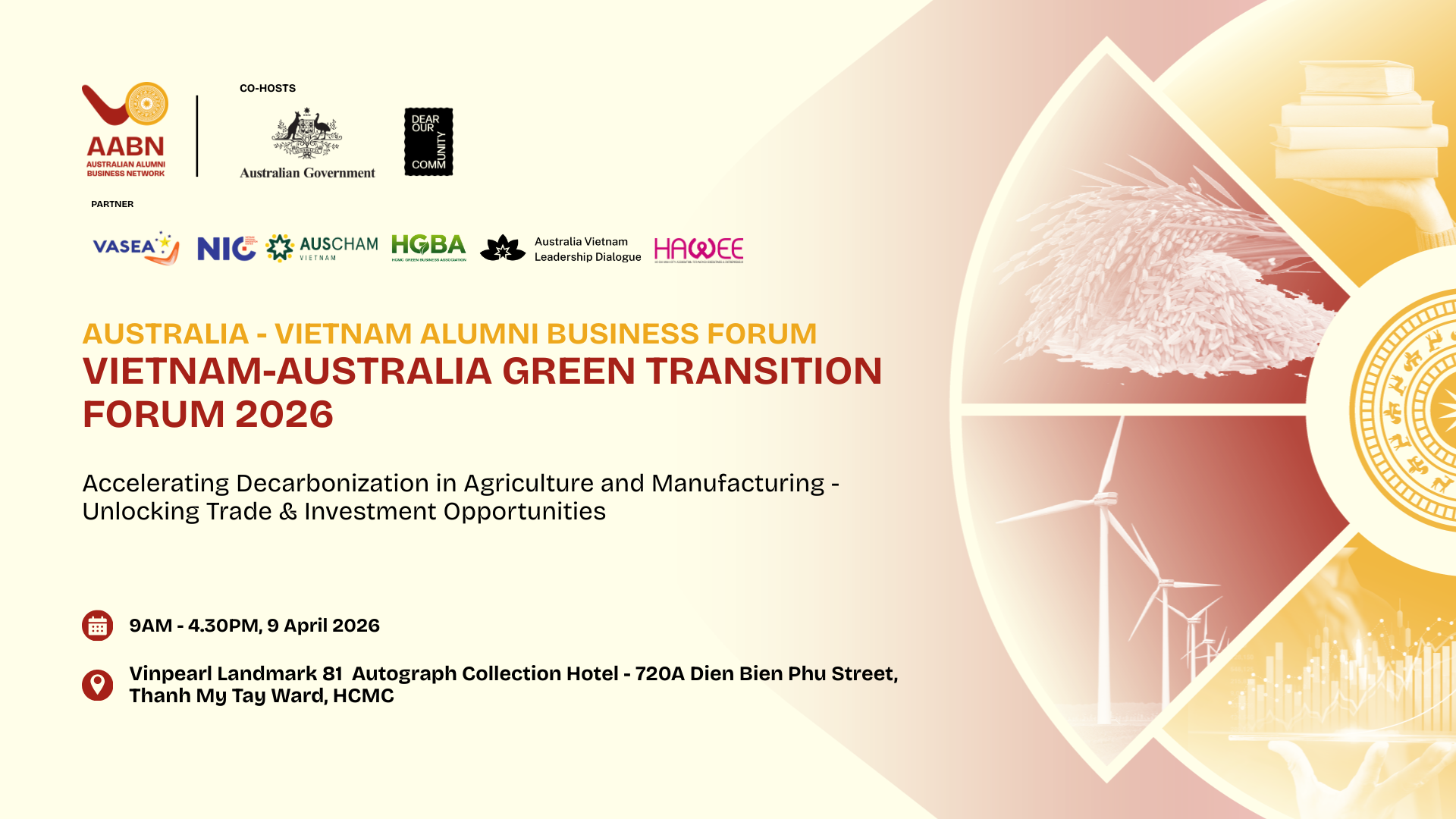
Professor Andrew Blakers, co-inventor of solar cell technology is coming to Ho Chi Minh City to share his insights in person. This is the session that can change how you think about what's possible for Vietnam’s green transition.
Register Now for the Vietnam–Australia Green Transition Forum 2026.
Seats are limited. Don't watch this from the outside.
Register Now: https://australianalumnibusinessnetwork.com/
REFERRAL SOURCES
• Wikipedia — Andrew Blakers: en.wikipedia.org/wiki/Andrew_Blakers
• ANU ICEDS Profile: iceds.anu.edu.au/people/academic-members/professor-andrew-blakers
• Queen Elizabeth Prize: qeprize.org/winners/professor-andrew-blakers
• Hydro Leader Magazine interview: hydroleadermagazine.com
• We Build Value interview (2024): webuildvalue.com
• ARENA Energy Innovators: arena.gov.au/blog/the-energy-innovators-andrew-blakers
• ANU Australia Day Honours (Jan 2025): anu.edu.au/news
• ANU RE100 Group: re100.eng.anu.edu.au/people/andrew-blakers